I can't lie, getting a new puppy is one of my favorite things in life. I love everything about it from researching and choosing a breed, to visiting breeders, shopping and training. And with each puppy I raise, I try to correct mistakes I made the previous time. Sometimes reading books and magazines gives you good ideas but very little real life experience. So for this post I thought I would make a list of things that have worked well for me when raising my own dogs.
Puppies are a blank slate, ready to be molded. Some unwanted behaviors are easy to spot from the start; jumping on guests for instance. If you don't want your adult dog doing that, don't ever allow it as a puppy. Pretty self explanatory, right? But other formed behaviors aren't quite as obvious to spot the connection between cause and effect. I want to hopefully help point out some of the not-so-obvious things that make a huge difference in how your puppy turns out, beginning before you even see him or her for the first time.
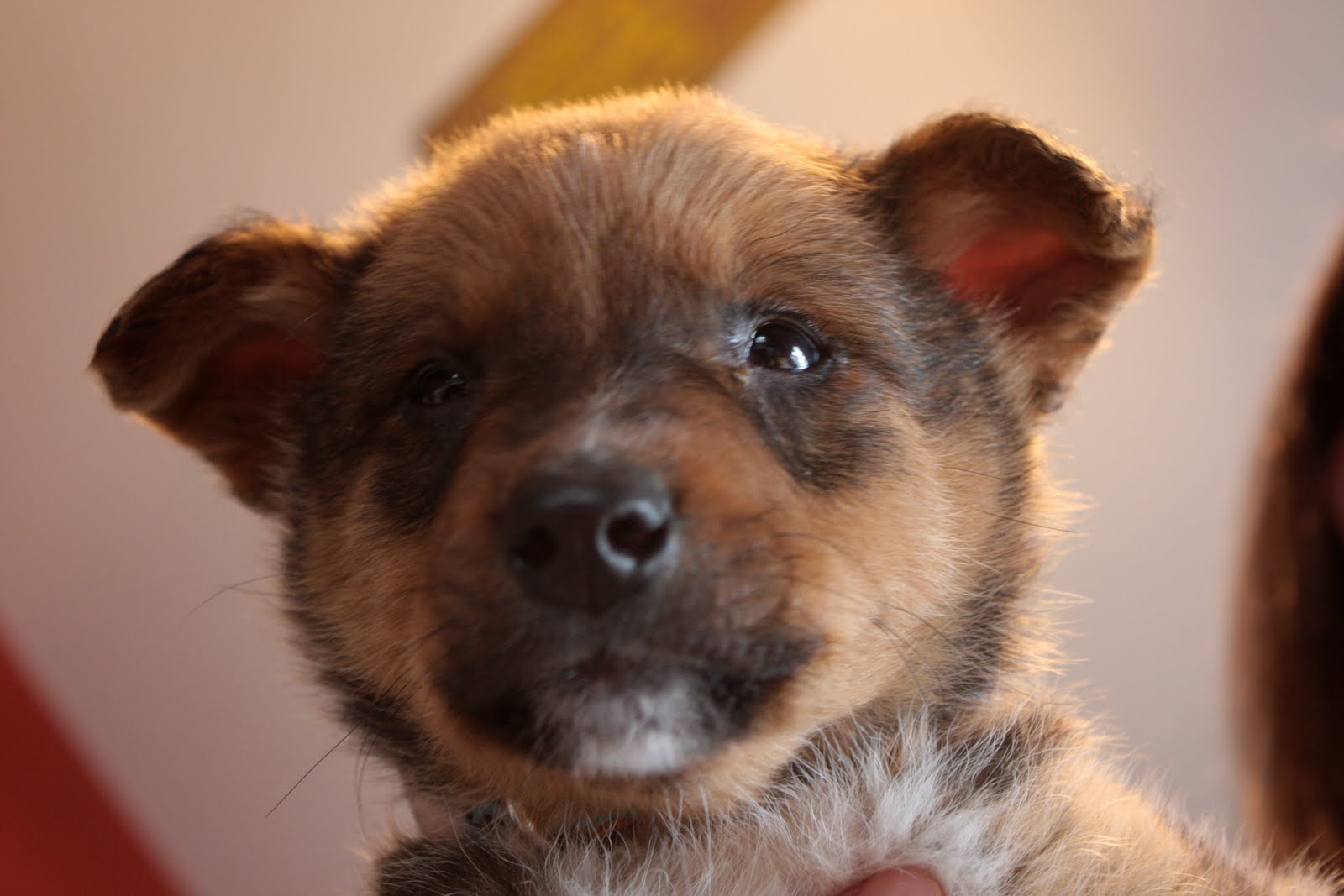
 8 week old Lab mix
1. Develop a vision before you even bring your puppy home
I don't know anyone who buys a puppy hoping it will become a problem dog that they eventually turn over to an animal shelter. Sadly though, that happens far too often and the evidence is in the millions of dogs abandoned at shelters each year, or worse, abused and neglected in someone's backyard. I believe the majority of these cases are the result of not enough planning.
It all starts with choosing the
right breed for you and your family. So first, make a list of all the qualities you want in a dog, then find someone who can help you choose a breed that lines up with your expectations. Even if you choose to go the adoption route, having an idea of what breeds suit you will help point you in the right direction at a shelter.
Some tactics I have learned when it comes to finding the right breed:
-Read, read, read. Buy books, read everything you can on the internet about the breeds you are interested in. Something that helped me greatly was finding breed specific message boards online and reading over the conversations amongst the owners of that breed.
-Ask questions. I have found that breed specific message boards and mailing lists are some of the greatest places to get my questions answered.
-Watch videos of the breeds you are interested in on youtube and on AKC.com
-Go to meetup.com, do a search for a breed, find out where the local meetup groups are and visit them. Most of the groups are happy to have visitors even if you don't have a dog of your own. It is one thing to read about a breed and an entirely different thing to see them up close and watch how they interact with each other and with people. I went to a Dachshund meetup group before I got Mud and it was one of the most helpful things I did when narrowing down breeds.
-Go to dog shows! www.akc.org has an "Events" search where you can find upcoming shows in your area.
Getting a puppy is not a race and I promise you that taking your time will be completely worth it. Once you have selected the breed with the traits that line up with your own, you now have the task of developing a more detailed vision.
Before deciding on a dog, something I learned for myself is to go through my daily life imagining that I
do have a dog. Imagine your dog there when you go to bed at night, when you wake up, when you get ready for the day, when you go to work, when you come home, when you go out with friends on the weekend, when you run errands etc. What will you do with your dog and how do you expect him to behave throughout your daily routine?
Vision is important when it comes to getting a dog not because you hope to turn your dog into a robot, but because it will be much easier to train and mold your puppy when you know very clearly the goals you are working toward. Choosing the right breed will help you develop goals that are realistic. In other words, you will always need to keep in mind that your dog is a living being with his own likes, dislikes, instincts and personality, and there will need to be room for compromise as well as structure. You will figure out with your own dog that sometimes letting him be who he is can be more freeing than trying to force something that is simply not there.
 "Kelly" 8 week old Lab mix
2. Habits and Consistency. Two words to write on your forehead.
Training begins the moment you pick your puppy up from the breeder's. Every new experience is a learning experience for him. Take advantage of this. If you don't want your adult dog on your furniture, don't let your puppy on the furniture either. It is much easier to form behaviors than it is to correct them, so keep that in mind from day one. This also applies heavily to house training. The goal in house training is to get your puppy in the
habit of eliminating himself in the right spot. If you take your puppy to the desired location at key times --after eating, sleeping, playing, or as a general rule every 2 hours-- soon enough it will become habit.
I usually teach my puppies how to sit on their first or second day home with me because I want them to grasp the concept of learning as soon as possible. It is rewarding to watch a 7-8 week old puppy's light bulb go on when they realize it's actually beneficial for them to pay attention to your voice. Once your puppy figures out that words actually mean something, and are connected to a reward, he will be on the right track to being attentive to you in the days to come.
When your puppy has learned how to sit on command, you can start having him sit before eating, before going through an open door, when guests arrive etc. If you practice these consistently (meaning
every time you feed your puppy,
every time you open a door,
every time a guest arrives) they will eventually become default behaviors for your puppy and that's how good manners are formed.
Make sure that you are being consistent in ways that make sense to your dog. Chasing your dog in a game and chasing him in an emergency are totally different scenarios to you, but to your dog, they are the same thing. This is why it's a good idea to only play chasing games that reinforce the recall command. For instance, wait until your puppy's attention is diverted from you, then whistle and run backwards in the opposite direction. Reward once your puppy reaches you. This is a chasing game that promotes the right idea. It's also equally important to never, ever punish your puppy for coming to you. If you need your dog to come to you for an unpleasent experience (nail clipping for example), go to
him, with some sort reward in hand, and calmly pick him up. Otherwise you will end up with a dog that weighs his options and decides whether or not it's worth it to come when called!
 8 week old Golden Retriever/Husky mix
3. Focus on only rewarding calm behavior
If you want to help curb separation anxiety and over excitement when you come home, don't make a big deal out of your coming and going. When you leave the house and put your puppy in his crate, toss a treat in, shut the door calmly and walk away without saying a word. Although tempting to say things like "Bye bye" and "We'll be back soon", remember that dogs don't understand English, they only hear words as cues, and saying these things consistently will only become cues for your dog to become anxious or nervous that you are about to leave. The same rule applies when you return home to your puppy. Running to his crate first thing and speaking to him in a high pitched voice will only intensify his already natural instinct to be excited about your return and will contribute to anxiety of all sorts. Overly excitable or submissive puppies have a tendency to urinate when greeting a visitor or when their owners return home. Almost always, the cure is to simply ignore your puppy (or have your guests ignore your puppy) when you come home. Give him time to settle down on his own before you pet him, give him eye contact or talk to him. (As
Cesar Millan calls it; no touch, no talk, no eye contact). Once your puppy has calmed down, ask him to sit and then calmly pet and talk to him all you want. By doing this, you are rewarding calm behavior rather than anxious behavior.
 "Bentley" 8 week old Pug
4. Socialize, socialize, socialize
Socialization is one of the most important aspects of raising a puppy. And it's equally important to do it
right. A good majority of behavior problems arise from lack of socialization at an early age.
Get your puppy accustomed to as many people, situations, and experiences as possible, particularly before the age of 16 weeks. But take care not to overwhlem your puppy. Puppies should be around a lot of kids for instance, but it is incredibly important that you supervise every child/puppy interaction to make sure the child never does anything unfair to the puppy. Kids are unpredictable in their movements and their moods and can easily hurt a puppy without realizing what they are doing. One traumatizing experience with a kid can make a dog forever uneasy around them, especially the smaller breeds. That being said, make an effort to get your puppy out in the world. Take him to outdoor malls, pet stores, puppy play groups, on walks, to friend's houses etc. Really anywhere that will allow your dog and is safe; go! Bring treats with you everywhere you go and hand them to strangers. I have done this with my puppies and most people are more than willing to give a treat to a cute puppy! If you see a kid or dog that looks too rambunctious for your puppy, steer clear until you are sure your dog is mature enough to handle it. You are the leader, but you are also your puppy's protector and it's detrimental that your puppy learns he can trust you to keep him safe.
Use common sense. There are times when your puppy will be frightened of things that are not dangerous. Even though our natural human reaction is to pick up and cuddle a scared puppy, what that does is actually affirm to your puppy that there
is something to be afraid of. This is why it's best to respond with patience and not force your puppy into doing something he is truly afraid of. But at the same time, encourage him to get over his fears. Never sound frustrated, rushed, or sorry for your puppy when he responds to something in fear. Let your body language and tone of voice be matter of fact. If you find yourself in a situation where your puppy is in real danger, do your best to rescue him from it without panicking.
I also highly recommend enrolling your puppy in puppy kindergarten. Not only will it be a great place to socialize your puppy on a consistent basis, but it will also be a great place to learn and get your questions answered on training and behavior. Most puppy classes work on obedience basics such as sit, down, stay, come etc. and practicing these things in a class setting is excellent experience for your puppy. Plus, you might find that you love working with your puppy so much that you would like to pursue competitive events and puppy classes are the perfect place to get connected.
Socialization is one of the most fun parts of owning a puppy! So don't forget to have fun!
 8 week old Golden Retriever/Husky mix5. Crate train
Crate training, if done right, is going to be one of the best things you do for yourself and your new dog. I say this because I have lived with dogs that are intolerant of crates and it's much easier living with a crate trained dog.
The most effective way to crate train is through a combination of freedom and assertiveness. What I mean by this is, it's good to start out slow. Throw a toy or a treat in your puppy's crate several times a day without closing the door behind him. Let him go in and out of his crate on his own. Another good way to speed up the process is to feed your puppy in his crate for the first several months of his life. When you feed, close the door and gradually increase the time you leave it closed after he has finished his meal. At first you may want to let him out right after he's done, and the next time, try keeping it closed for a few extra minutes.
On the contrary, you also need to be a little head strong when it comes to crate training. When it's time to put your puppy to bed for the night, don't give into his whining, even if it turns to screaming! Make sure your puppy has eliminated himself directly before bed. The goal is to teach your puppy that crying does not get him out of his crate. Which leads to the next crate training tip; only let your puppy out when he's being calm and quiet. Do your best to never reward anxious behavior. Very young puppies may need to be let out once or twice during the night, so if your puppy is still whining 4 hours after you put him to bed or wakes up and whines, let him out again and put him back in his crate once he has gone potty. This way, you will at least know that his whining is not because he is trying to tell you something.
Crate training is also an invaluable housetraining tool. This is because puppies naturally do not want to soil their bedding, so you can use that to your advantage, but be careful not to abuse it either. Puppies can only hold it for so long, generally 4 hours at most for 8 week - 6 month old puppies and 2 hours for puppies younger than that. Put your puppy in his crate when you can't supervise him and when you fetch him out of his crate, take him to his potty area first thing. This will speed up the house training process immensely.
Never, ever, use your puppy's crate as punishment. You always want your puppy to associate his crate with good things. Also, dogs don't respond to "time outs" because they live in the moment. Your timing has to be perfect in order to correct a behavior, otherwise your dog will simply not connect cause and effect. Yes, your dog will learn to perceive when you are angry with him and will react accordingly, but that does not mean he understands WHY you are mad.
Make sure you get a crate of the proper size. A crate that's too large may cause your puppy to use one side as a toilet area and one as a bed. But you also want it to be big enough for your dog to be comfortable in when you leave him for long periods of time.
 "Mud" 7 week old Miniature Dachshund
6. Don't give up
Too many people give up when it gets hard. Dogs are most commonly relinquished to shelters between the ages of 1 and 3. This is the adolescent stage when dogs are no longer irresistible puppies, and their owners either lose interest or don't want to put the extra work into dealing with a teenager. But take it from me, it
will get easier.
Whatever it is that you have decided you want your dog to learn, don't give up and don't give in. Certain behaviors will take longer to become habits for your dog and will require more patience from you, but hold on.
As an example, my Dachshund, Mud, despised being confined to any sort of crate or play pen from 7 weeks through about 6 months of age. He would scream at the top of his lungs to the point where I would actually think something was physically wrong with him. I almost gave up hope, thinking he was just going to be one of those dogs that can never be crated, but knowledgeable dog friends of mine encouraged me not to give up and I am so glad I took their advice! Today Mud has 2 crates; one he sleeps in and one in the car and he happily goes into both on his own and will stay there with no problem even with the door closed. It definitely comes in handy when we take him to friend's houses and when we have to leave him home alone!
Some things may take more time than others depending on your individual dog and your previous training experience. But that's not a reason to quit prematurely!
 8 week old Lab mix7. Accidents will happen
...and when they do, don't be too hard on yourself. If your puppy makes a mistake on the carpet, learn from it, clean it up, and move on!
 "Ruby" 10 week old Yorkie
Lastly, here are a few book and magazine recommendations! All of these have helped me in one way or another!
How to Raise the Perfect Dog by Cesar Millan
Cesar's Way by Cesar Millan
Popular Dog Series Magazines
Family Dog by Richard A. Wolters
 (All photos taken by Tory Cobrea)