Where does your dog go when you have to leave him/her during the day?

11 February 2011

Dental Health

Anyone who has a dog or has even been around a dog can probably agree that dog breath is a force to be reckoned with. In extreme cases, a dog's bad breath can serve as a red flag for more serious issues - infection, pain, and even possible organ damage. The good news is that a dog's dental health can be greatly impacted with preventative care and maintenance! February is National Pet Dental Health month, so at the suggestion of a friend, Tory and I thought it would be a good idea to feature this topic. Your dog's teeth (and possibly your nostrils) just may thank us for it.

Just like your own teeth, a dog's teeth are going to suffer decay without the regular removal of tartar build up. It is not necessarily natural for a dog to enjoy having someone poking around in his or her mouth. This is why it is extremely advantageous to teach your dog to have his or her mouth examined and worked with from day one. You may have to start simply by getting your dog used to having his or her mouth touched. Then, introduce the taste of the paste. Finally, introduce a soft bristled brush with the paste on it.

Just so we're all on the same page here - you must buy special toothpaste for your pet. Using regular human toothpaste is dangerous for your dog. One highly veterinarian-recommended brand of toothpaste for dogs is CET. The pastes come in several appealing flavors that are safe for your dog to ingest.

Brushing your dog's teeth is not the only way to enhance dental health, though. Providing toys and bones for your dog to chew on can also aid in the prevention of tartar build up.


Rag bones can serve as a sort of floss for your dog. (Just be sure to supervise while in use, as dogs can swallow string and this is often hazardous.)


Toys with texture and ridges, such as this one, stimulate gums and help break down tartar on the teeth.


Real animal bones such as these femur bones provide hours of chewing time for dogs. (They do pose a risk for wear and tear on dog teeth, however; so use with discretion.)


Using an additive to your pet's drinking water like this one can is an easy way to further promote oral health.

Having a periodic dental done by your veterinarian for your dog is also a crucial part of preserving your dog's healthy teeth. This is done while your dog is under anesthesia, and while it can be pricey, I can personally attest to the value of having this done. Gabe is a three-year-old healthy dog, but when I had a dental done on him several months ago, they discovered he had not just one, but two broken teeth! Thankfully, neither of the teeth were in need of a root canal because we caught it in time. They were able to seal each of them and prevent any worse pain in his mouth. I would much rather provide preventative care for my dog than needing a painful emergency procedure done later on down the road.

Many veterinarians offer discounts on pet dentals during the month of February, so now is an ideal time to have your pet's mouth checked out! We highly encourage you to help preserve your dog's 'smile'.

08 February 2011

Gabe's First Trial! (and Error...?)

This past weekend, Gabe and I competed for the first time in agility. It was a milestone for us because it's something I have wanted to work towards for several years now. However, due to moving around a lot, not having money to pay for classes, and my own lack of confidence, it took us longer than it should have to accomplish this.

The trial we entered was a NADAC (North American Dog Agility Council) trial. They allow both mixed breeds and purebred dogs to compete (as does the American Kennel Club now), and we only entered two classes, since I wasn't sure what I was getting myself into exactly. I decided on two 'Touch-N-Go' events, which focused on contact obstacles. These courses mainly consisted of the A-frame, the Dogwalk, hoops, and tunnels.

I didn't set unrealistically high goals for Gabe and myself; mainly, my objective was just to get through each course, and hoped that he would do more than just sniff the ground or run out of the ring completely. I had no idea what he would think of the trial environment (a horse barn - are you kidding me?), equipment different than what he was accustomed to using, and of course an audience.

The things I learned that day were:
1. Everyone makes mistakes. Especially Novice handlers.
2. If I ever reach the higher competition level classes, I never want to become condescending or arrogant (like some of the elite handlers unfortunately were.)
3. Gabe really needs some sort of a warm up run, to get rid of the squirrely tendencies he has.
4. Laughing at Gabe and myself is helpful.

I will post the footage from both of our runs. Please watch both, as he improved greatly from the first run to the second! (It is ok if you laugh while watching, too - he is slightly over-enthusiastic and had the time of his life. It is what I adore about him. :))

Run 1

Run 2

More trials to come, hopefully!

02 February 2011

I love you more than I could ever promise

Saw this video today and felt it was definitely worth posting. Of course, anything with a Dachshund melts me. But that's beside the point. This is just sweet.

01 January 2011

Friends

I took a few pictures of my dogs (Mud & Cinderella) playing in the snow the other day. Unfortunately, Mud ran outside before I could get his matching blue sweater on him. He was like a little boy overly excited about the snow with his mom calling after him "don't forget your jacket!"
But in the end I couldn't interrupt his fun to dress him up. So just imagine he is wearing a wintry outfit to match Cinderella's. (And at least he had his Harley Davidson collar on that he got for Christmas from my mom!)


(click pix to enlarge)


24 December 2010

I'm going to be cliche and title this post "Santa Paws".


Just a quick post to say Merry Christmas from Hot Diggity, and also from Izzie, a 3.75 year old Cairn Terrier owned by Trevor Gibson! These pictures of Izzie, taken by Trevor, were too cute and festive not to share on the blog!

A little more about Izzie...

Where did you get her? At a small breeder in Arlington, WA.

What made you choose her? She was small and cute, with a lovable and bubbily personality.

How did you pick the name Izzie? Not really sure. Her full name is Isabella, and we originally called her "Bella". After her full personality bloomed, we decided that "Izzie" was a more fitting name.

Describe Izzie in three words: Peppy, confident, loving.


She sounds like everything a Cairn Terrier should be :)


Trevor is a professional photographer from Seattle, WA. Check out more of his work here at www.prosightmedia.com (Yes, he works with pets, and yes, you will find more adorable pictures of Izzie on his website!)


(click to see larger!)


Thank you Trevor for letting us show off Izzie! (And your photography skills).

16 December 2010

Meet Gallagher

Great Danes are eye-catching dogs. Their giant size alone makes them an impressive breed; even before getting to know their delightfully gentle spirit! So, when I saw this picture of a friend's Great Dane with the loveliest black spots and red bow decked out for Christmas, I knew it needed to be shared on the blog. Thank you to Kevin Claussen for sharing Gallagher with us, and to his sister-in-law Jada for taking the photo!

Name: Gallagher
Breed: Great Dane
Age: 1 year 2 months
Where did you get him?: Got him from Moffit Colorado. Took about 10 months to find "the perfect Dane."
How did you pick him?: I picked him because of his unique markings of black and white and knew it was a decision I would not regret.
How did you name him?: Picked the name Gallagher because it fits perfectly for gentle giant.
Use three words to describe him: Unique, friendly and playfull.


Gallagher was an adorable puppy - so easy to see why he was picked by Kevin!


Thanks again for sharing Gallagher with us - he is the perfect dog to feature this month!

10 December 2010

Dog Sports - Agility

My favorite dog sport is, by far, the sport of agility. Created in the 1970s as a 'half-time' performance at the Crufts dog show, it has now rapidly gained popularity world-wide in just a few short decades. Although some athletic breeds (many herding breeds like Border Collies and Australian Shepherds) are most prone to excelling at agility because of their speed and intelligence, it is enjoyed by people and dogs of all shapes, ages, and sizes. And, as the owner of a mixed-breed dog, I have always appreciated agility because it presents many opportunities for dogs of all kinds, not just registered purebreds (depending on the trial and the organization.) And, Gabe LOVES agility!

The main objectives of dog agility are speed (each team is timed) and accuracy on the obstacles, which are set up in various patterns to form a course. Faults in agility can include things like knocking bars off of jumps, missing contact zones (to be discussed below), missing an obstacle altogether, or running a course out of order. Dogs take both verbal cues and body cues from the handler (but no touching is allowed), so it is definitely a team effort between handler and dog.

Courses are set up by a judge or teacher, so each handler has a chance to walk the course and memorize it before running it with the dog. Trials can take place indoors or outdoors. This is an example of a course map, each handler-dog team starting at 1 and following the numbers in order:


Possible obstacles that can be seen on any agility course include the following:

1. Jumps or hurdles (can be a panel jump, broad jump, bar jump, double or triple jump, or tire jump.)


Gabe with a regular jump.


Gabe with the tire jump.

2. Tunnels (regular, or chute)


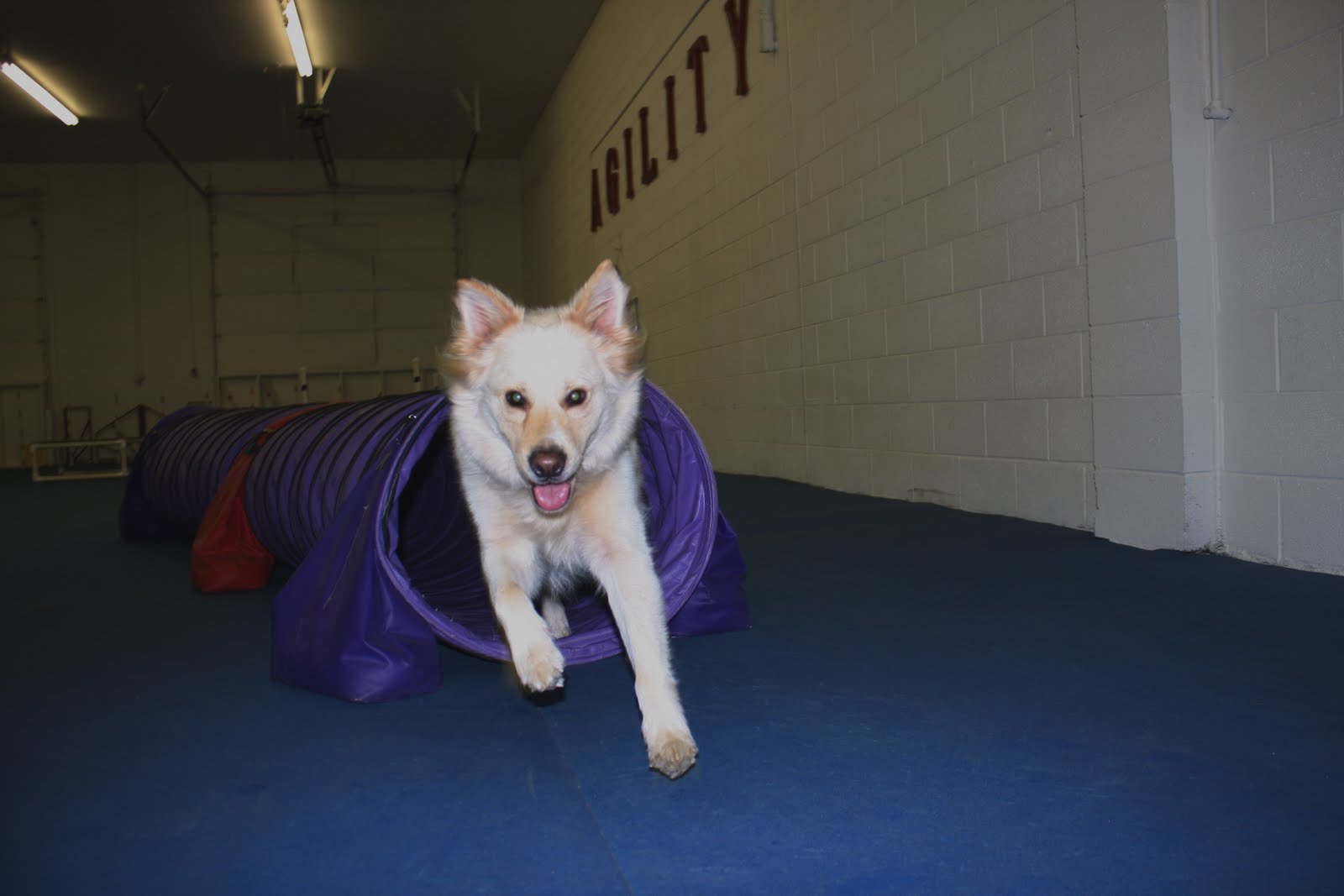
Gabe running a regular tunnel.

3. Pause table (dog must be in a 'down' position for five seconds)


Gabe on the table.

4. Weave poles (five to twelve poles the dog must weave through, always entering with the first pole on the dog's left shoulder.)


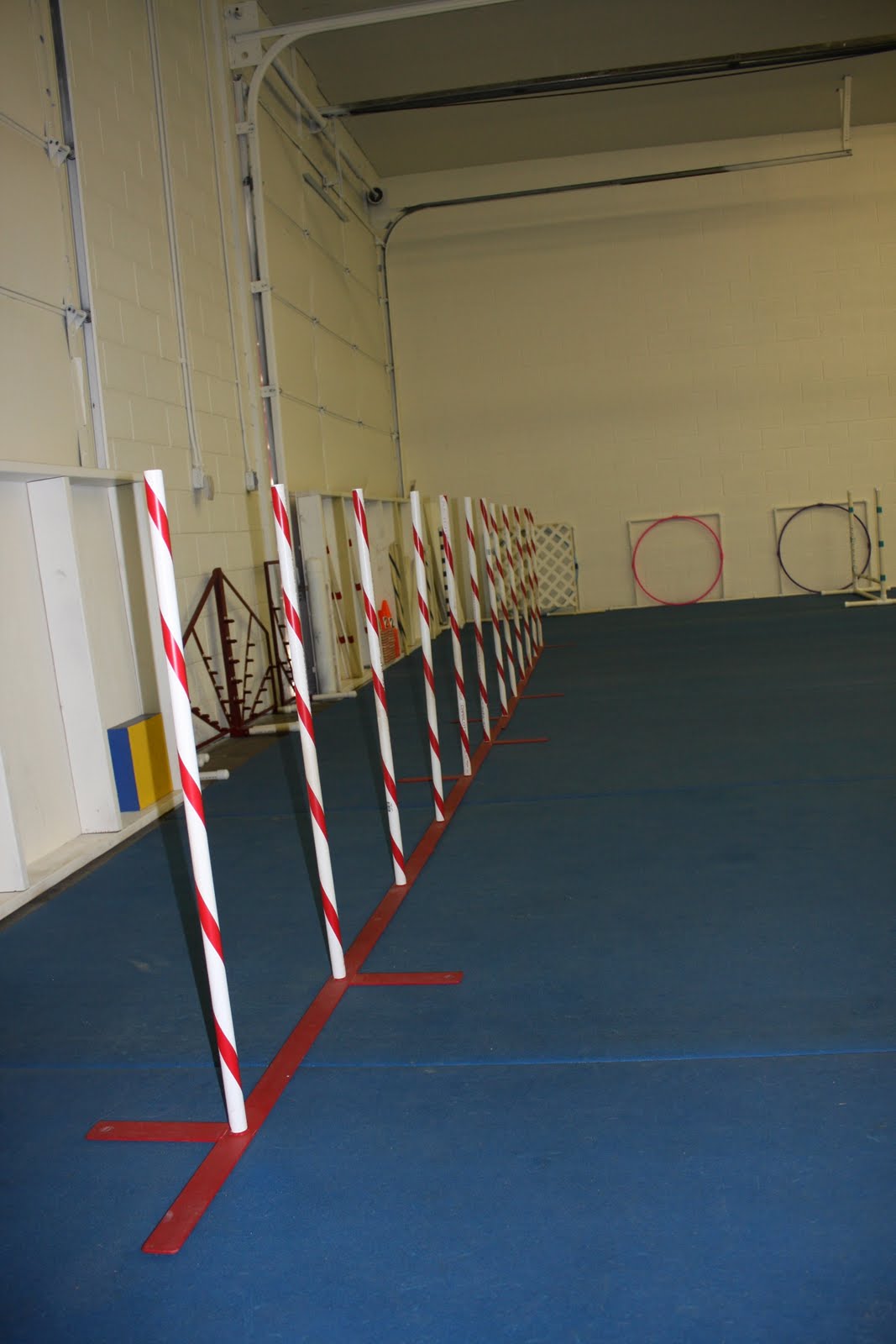
The poles, minus Gabe.

5. A-Frame (a contact obstacle in which the dog must make contact with the brightly-painted areas while both ascending and descending.)


Gabe on top of the A-Frame.


Approaching the contact zone.


Coming down the A-Frame.

6. The Dogwalk (another contact obstacle)


Making his way across the Dogwalk.


Approaching the contact zone.

7. The Seesaw or Teeter-Totter (the most difficult of the contact obstacles)


A slowed-down look at the Teeter and making the contact zone.

Whether it be for fun, or for competition, dog agility can be a great way to build confidence in your dog and provide much-needed mental and physical stimulation! For more detailed information on how to get involved in this sport, check out:

NADAC (North American Dog Agility Council)
AKC (American Kennel Club)